A catalogue essay has to stand next to the paintings for years after the exhibition closes, so it is the text where an art historian’s reading of an artist is most exposed. These are essays I wrote for five exhibitions at Goldens Auction House, all curated by Mykhailo Vasylenko, along with my artist essays and interviews for the books 30 Years of Presence and 25 Years of Presence and a review of Ganna Kryvolap’s exhibition in Montenegro. They are the same kind of writing I now do as a catalogue essay writer for galleries and auction houses.
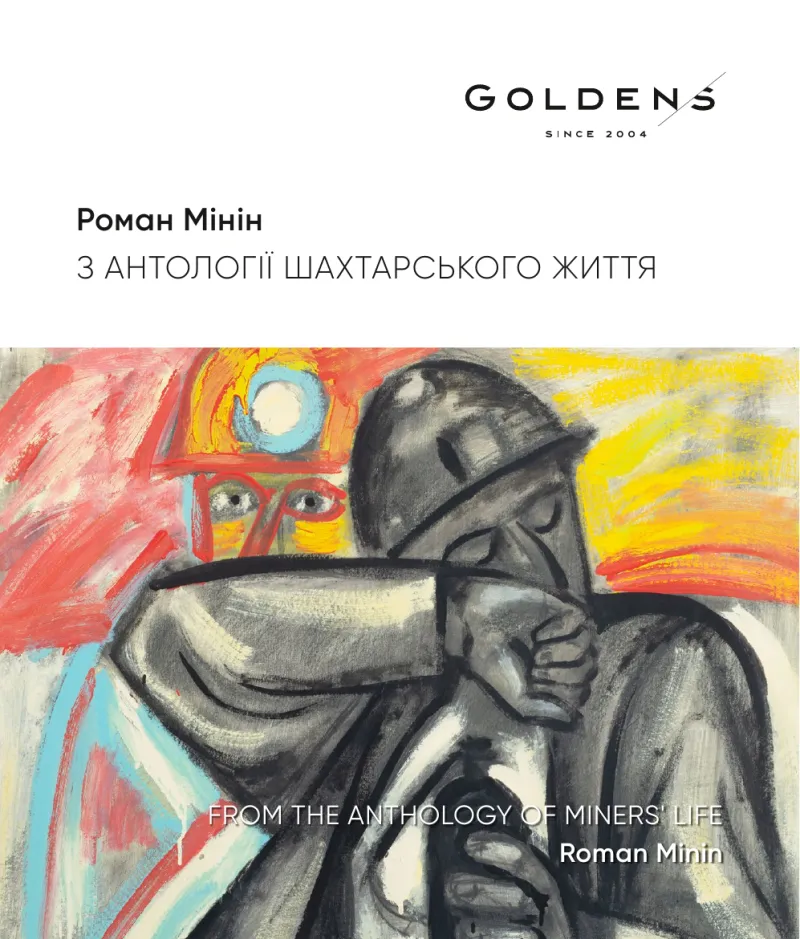
Roman Minin, “From the Anthology of Miners’ Life”
Goldens Auction House, Kyiv, 2026. Exhibition 19 August to 4 September 2026, curated by Mykhailo Vasylenko. Ukrainian and English, 19 pages. Essay: “A plastic prayer for the miners.”
There are images that, over time, become witnesses to history. The miner in Roman Minin’s work is one of them. Born in Dymytrov in the Donetsk region, the artist approaches the miner not as an individual figure, but as an image in which the memory of Donbas, industrial mythology, family continuity, and everyday coexistence with death converge.
In his student works of the early 2000s, Minin does not seek to portray the miners’ world through a documentary lens. Instead, he takes it out of a specific social context and into the plane of generalization. His figures remain recognizably the people of the Donetsk mines, yet at the same time they exist outside time. “My miners are calm. They have become eternity,” the artist says of them.
[…] This is why the “plastic prayer,” as the artist calls his work with miners, is not a metaphorical embellishment, but a precise description of his artistic method. The prayer is enacted through the very act of granting the image eternity. Minin promises his figures no salvation, does not turn them into romantic martyrs, and makes no attempt to justify the system in which they lived. He stops them in time. Their eternity does not mean victory over death. It belongs to art.
Excerpt from the essay in the catalogue published by Goldens Auction House.
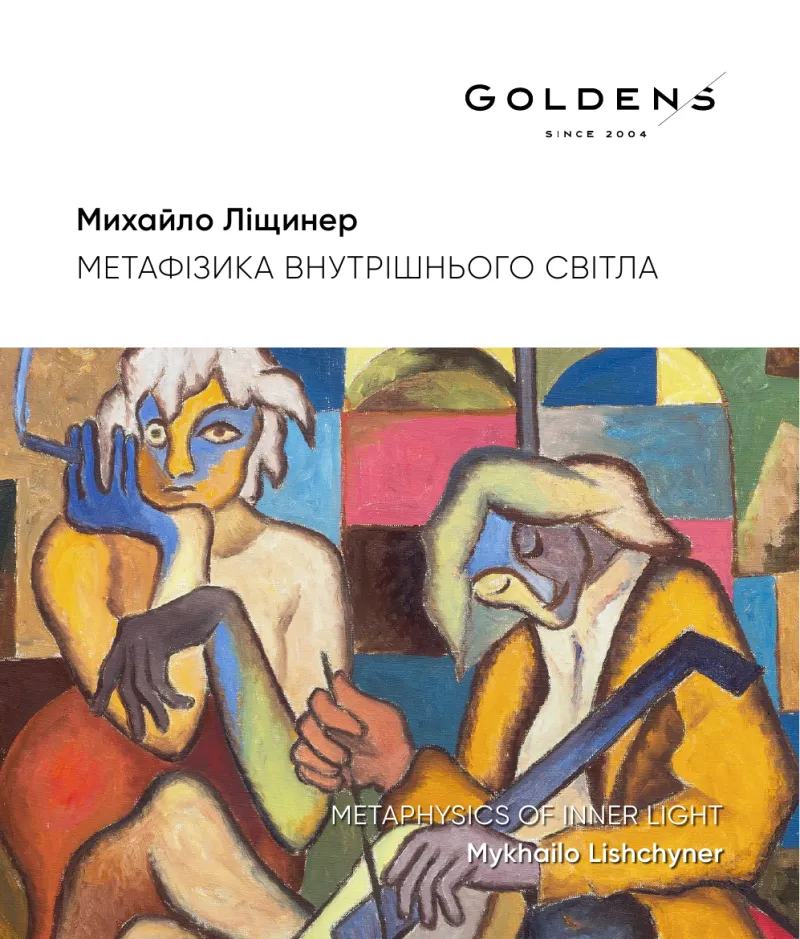
Mykhailo Lishchyner, “Metaphysics of Inner Light”
Goldens Auction House, Kyiv, 2025. Exhibition 13 November to 4 December 2025, curated by Mykhailo Vasylenko. Ukrainian and English, 23 pages. Essay: “An artist of inner resistance.”
At first glance, Mykhailo Lishchiner seemed like an ordinary Soviet artist, a member of the Union, a teacher, an author of subjects approved by the censors. But if you pause before his paintings even for a minute, you realize how mistaken that impression was. His colors, compositions, and figures carry doubt, freedom, inner integrity, and individuality. These were qualities that could not exist in the official art of the USSR.
In the postwar Soviet Union, a rigid system of ideological control governed the arts. Any deviation or declaration of new formal experiments meant professional suicide, and sometimes even physical exile. On the surface, Lishchiner chose a perfectly acceptable figurative realism, creating genre scenes with characteristic titles, within which he concealed an aesthetic contraband.
So Lishchiner only appeared to be a Soviet artist. In fact, he created a language of inner resistance, which is why his art remained relevant even after Socialist Realism had vanished, both as an ideology and as an aesthetic.
[…] In Bottle Parade (1972), Lishchiner transforms a still life into an intellectual composition, where objects create a rhythmic system of forms and planes. The composition is organized vertically. Light is evenly distributed and serves as a vehicle of abstract thought rather than a source of natural illumination. The parade of bottles carries an ironic undertone and stands as a quiet protest against the standardization of Soviet life.
Excerpt from the essay in the catalogue published by Goldens Auction House. English translation by Olha Svyripa.
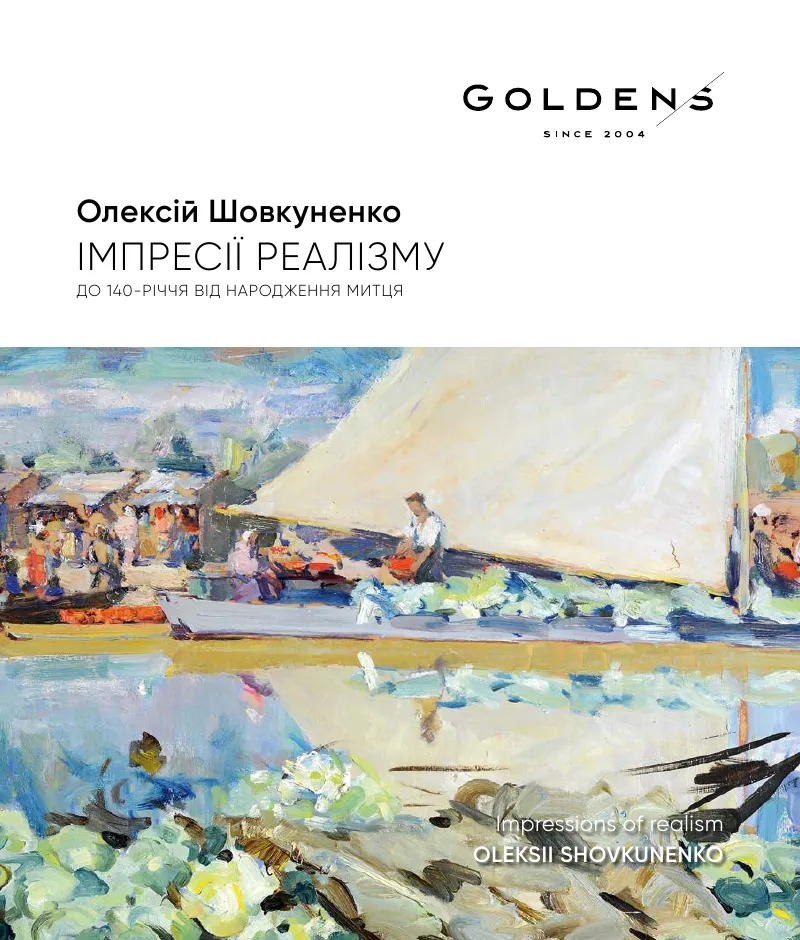
Oleksii Shovkunenko, “Impressions of Realism”
Goldens Auction House, Kyiv, 2024. Exhibition 8 to 25 May 2024, for the 140th anniversary of the artist’s birth, curated by Mykhailo Vasylenko. 23 pages. Essay in Ukrainian.
Shovkunenko was one of the first Ukrainian painters of the industrial landscape and won a gold medal for watercolour in Paris in 1937. The essay follows how his native Kherson stays in his work as memory, from the Green Bazaar series to landscapes painted from recollection rather than from nature. It also reads the impressionism he took from his teacher Kyriak Kostandi against the Soviet campaign on “painterliness” in the early 1950s, which may be why he never publicly called himself an impressionist.
Essay in the catalogue published by Goldens Auction House.
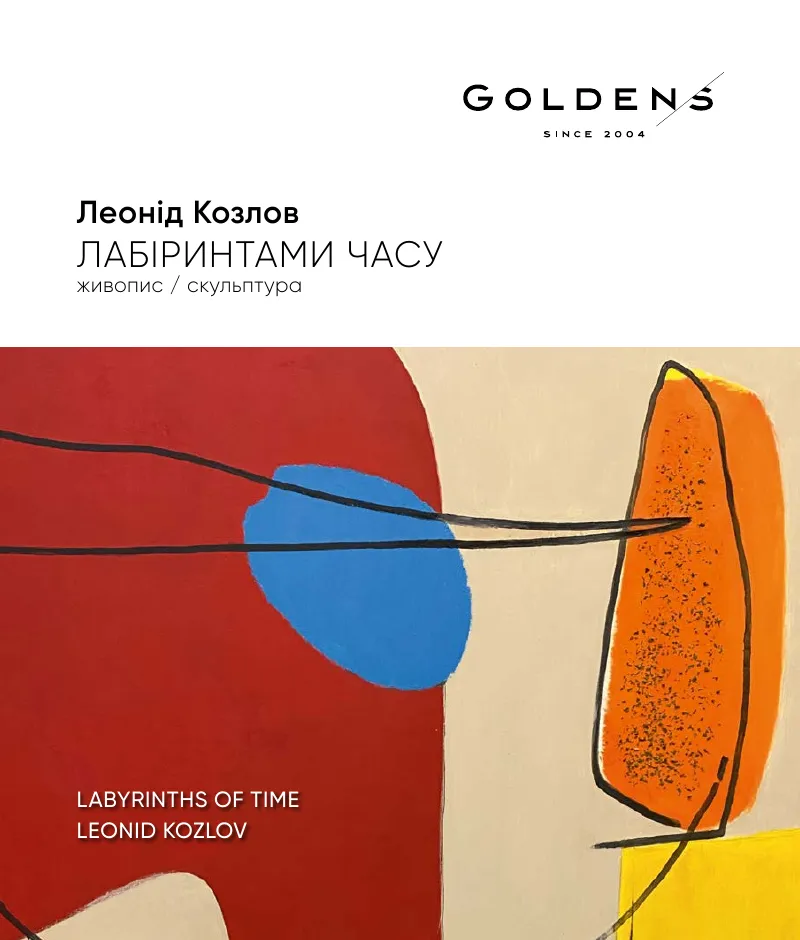
Leonid Kozlov, “Labyrinths of Time”
Goldens Auction House, Kyiv, 2024. Exhibition of painting and sculpture, 20 March to 12 April 2024, curated by Mykhailo Vasylenko. 25 pages. Essay in Ukrainian.
Kozlov trained as a classical sculptor and became known for his ballerinas, caught just before or just after the dance. The essay traces how he stripped his sculpture down to abstraction and carried the same search into painting: the bronze Figure, which recalls both Palaeolithic Venuses and Lot’s wife, and canvases such as Black Ploughland and Red Glow, where sawdust, earth and sand go into the paint.
Essay in the catalogue published by Goldens Auction House.
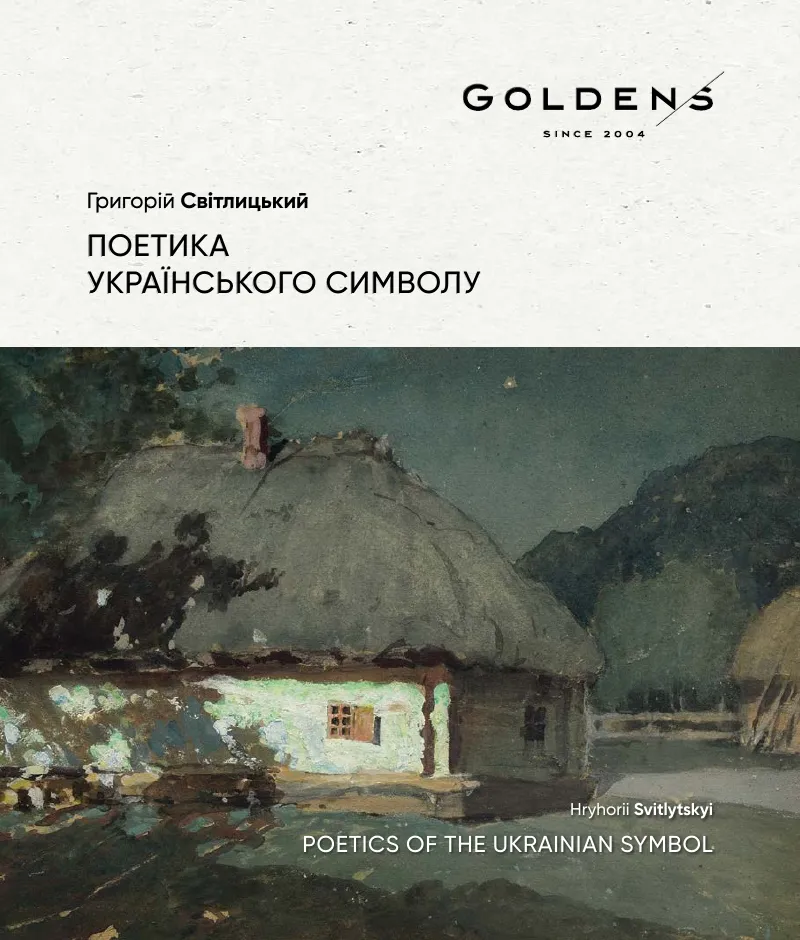
Hryhorii Svitlytskyi, “Poetics of the Ukrainian Symbol”
Goldens Auction House, Kyiv, 2023. Exhibition of works from private collections, 28 June to 22 July 2023, curated by Mykhailo Vasylenko. 21 pages. Essay in Ukrainian.
Newspapers called Svitlytskyi (1872–1948) “the Ukrainian Kuindzhi”, and the essay argues that the label misses him. Where Kuindzhi wanted realism, Svitlytskyi dressed it in the poetics of the symbol: the Gogolian Ukrainian night, and the village house as a relic of memory that returns in Moonlit Night and Night in the Village. His landscapes keep the tie with Ukraine that neither imperial Russification nor Soviet devaluation could break.
Essay in the catalogue published by Goldens Auction House.
30 Years of Presence: Contemporary Ukrainian Artists, 1991–2021
Institute of Problems of Contemporary Art of the National Academy of Arts of Ukraine, with ArtHuss, Kyiv, 2022. Idea and curation by Ihor Abramovych. In Ukrainian.
The book follows the Ukrainian artists who shaped the three decades after independence, with each artist given a short essay and a spread of works. I was one of nine art historians on the project and wrote the essays on Matvii Vaisberg, Ihor Gusev, Pavlo Kerestey, Ganna Kryvolap, Oleksa Mann, Oleksandr Roitburd, Arsen Savadov, Sergei Sviatchenko, Illia Chichkan, and Masha Shubina.
The PDF below contains only my ten essays with their pages of works, plus the cover and the colophon. The full book is available from ArtHuss.
25 Years of Presence: Contemporary Ukrainian Artists
Institute of Problems of Contemporary Art of the National Academy of Arts of Ukraine, with ArtHuss, Kyiv, 2017 (title page dated 2016). Idea and curation by Ihor Abramovych. Two volumes, in Ukrainian.
The first book in the series, published for twenty-five years of Ukrainian independence. My part here was mostly conversation: I interviewed twelve artists, APL 315, Volodymyr Bovkun, Anna Valieva, Anton Logov, Oleksandr Roitburd, Arsen Savadov, Andrii Sydorenko, Anatol Stepanenko, Vasyl Tsagolov, Illia Chichkan, Mykyta Shalennyi, and Masha Shubina, and wrote short essays on three large canvases, Roitburd’s Earthly Love and Heavenly Love, Savadov’s Gulliver’s Dream, and Tsagolov’s Critical Degree. The first volume also opens with my foreword, one of the introductions by the six art historians on the project.
The PDF contains only my texts with their pages of works, plus the cover and the colophon of each volume.
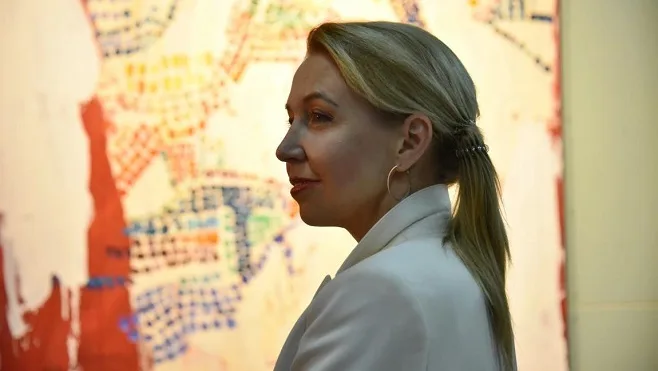
Ganna Kryvolap, “Involvement”
Review of the solo exhibition at Dukley Gallery, Budva, Montenegro, curated by Marat Guelman. Written for ArtsLooker and published in English on the artist’s website.
Twenty-two paintings from Kryvolap’s mosaic series, made after she touched ancient Montenegrin mosaics. The review reads the series through Plato and Henri Bergson and follows how she treats paint as a monumental, almost architectural material, with references that run from Byzantine smalt to the pixel.
Published on Ganna Kryvolap’s website.